
The Thing Nobody Explains
You tap a ring against a phone. The phone opens a page. No app. No Bluetooth. No charging. Nothing installed.
Most people accept that and move on. But if you have ever wondered what is actually happening inside that half-second, the answer is genuinely interesting.
It Starts With the Phone's Radio
Every modern smartphone has an NFC chip inside it. That chip broadcasts a tiny radio frequency. We are talking about 13.56 MHz. You cannot feel it. You cannot hear it. But it is there, pulsing outward a few centimeters from the back of your phone.
It is always on. It is always listening. It is waiting for something to answer back.
The Ring Has No Battery. So How Does It Answer?
This is the part that surprises people.
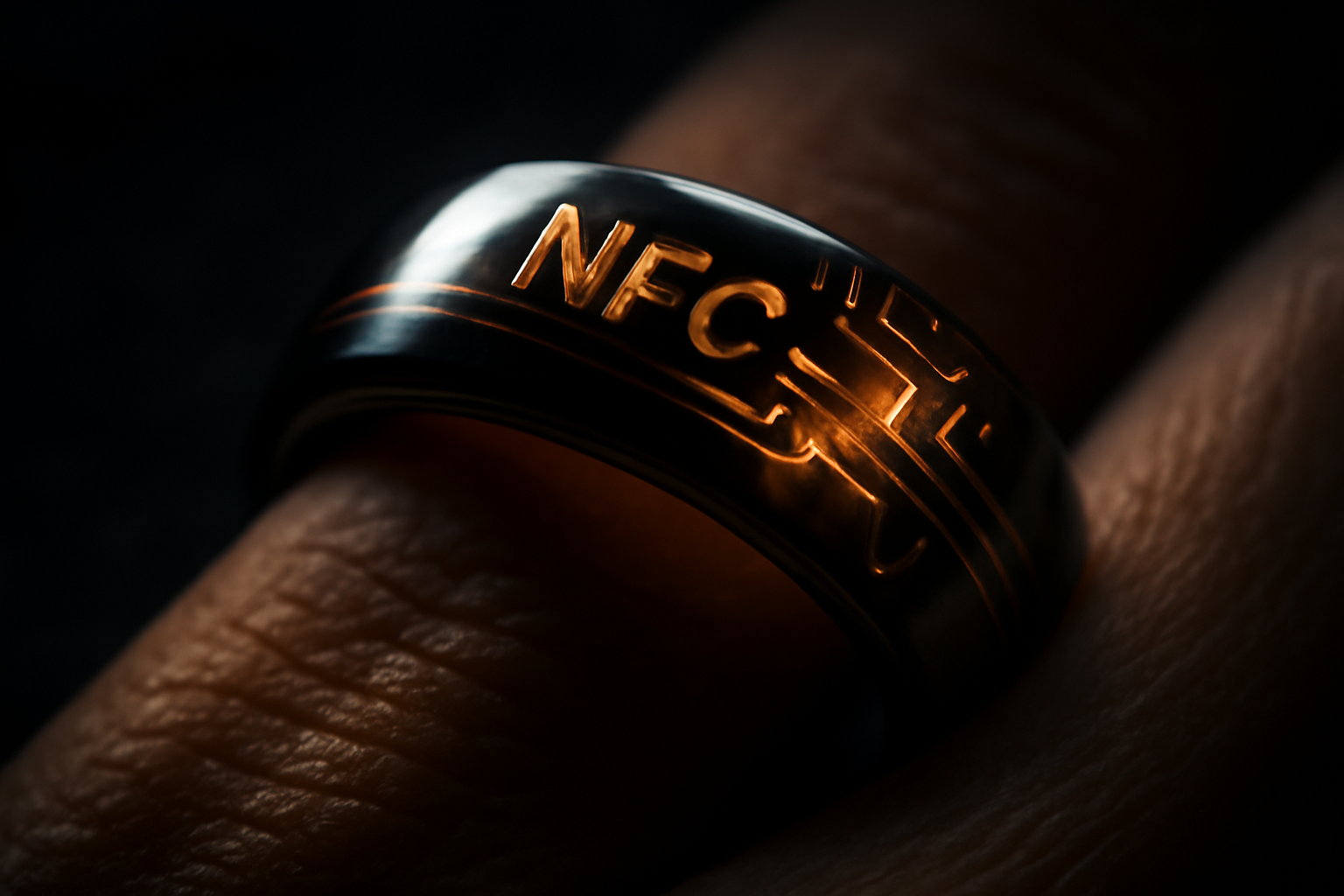
Inside a TapRing, there is a small coil of wire wound around the inside of the band. When you bring that coil close to the phone's radio field, something happens called electromagnetic induction. The radio waves from the phone pass through the coil and generate just enough electrical current to power the chip for a fraction of a second.
The ring borrows power from the phone to respond. That is why it never needs charging. There is nothing to charge. The energy comes from the device reading it.
What Gets Sent in That Fraction of a Second
The chip stores a URL. That is it. When the phone powers the chip and reads it, the chip sends back that URL. The phone sees a web address, opens it in the browser, and your digital profile appears.
The whole thing happens faster than a tap-to-pay transaction at a coffee shop.
No data is pulled from the phone. No app is triggered. No permission is required. The phone just follows a link, the same way it would if you typed an address into a browser.
Why a Ring Works Better Than a Card for This
NFC cards work on the same principle. The physics is identical. But a card lives in your pocket, your bag, your desk drawer. A ring lives on your hand.
Your hand is already part of every introduction. You shake hands. You gesture. You reach for something. The ring is present at the exact moment a connection is being made, not somewhere in the bottom of a bag.
That proximity is the whole point.
Why It Works Through the Ring Material
NFC signals pass through non-metallic materials without any problem. The ring material is not blocking anything. The coil inside is positioned to sit close to the inner edge of the band, which is the part closest to whatever surface you are tapping.
The geometry is intentional. The signal does not need to travel far. It just needs the coil to be near the phone's NFC antenna, which is usually near the top or middle of the back panel.
Tap that spot. Done.
What the Other Person Experiences
Nothing complicated. Their phone buzzes or lights up. A browser opens. Your name, your photo, your contact details, your links. All of it sitting there like a webpage they navigated to on purpose.
They do not download anything. They do not scan anything. They do not type anything.
They just look at what you sent them.
The Short Version
The phone powers the ring for a split second. The ring sends back a URL. The phone opens it. You look like someone who thought this through.
TapRing starts at $45. The Pro plan is $5.99 a month, or $2.99 a month on a yearly plan. One tap and the physics does the rest.