
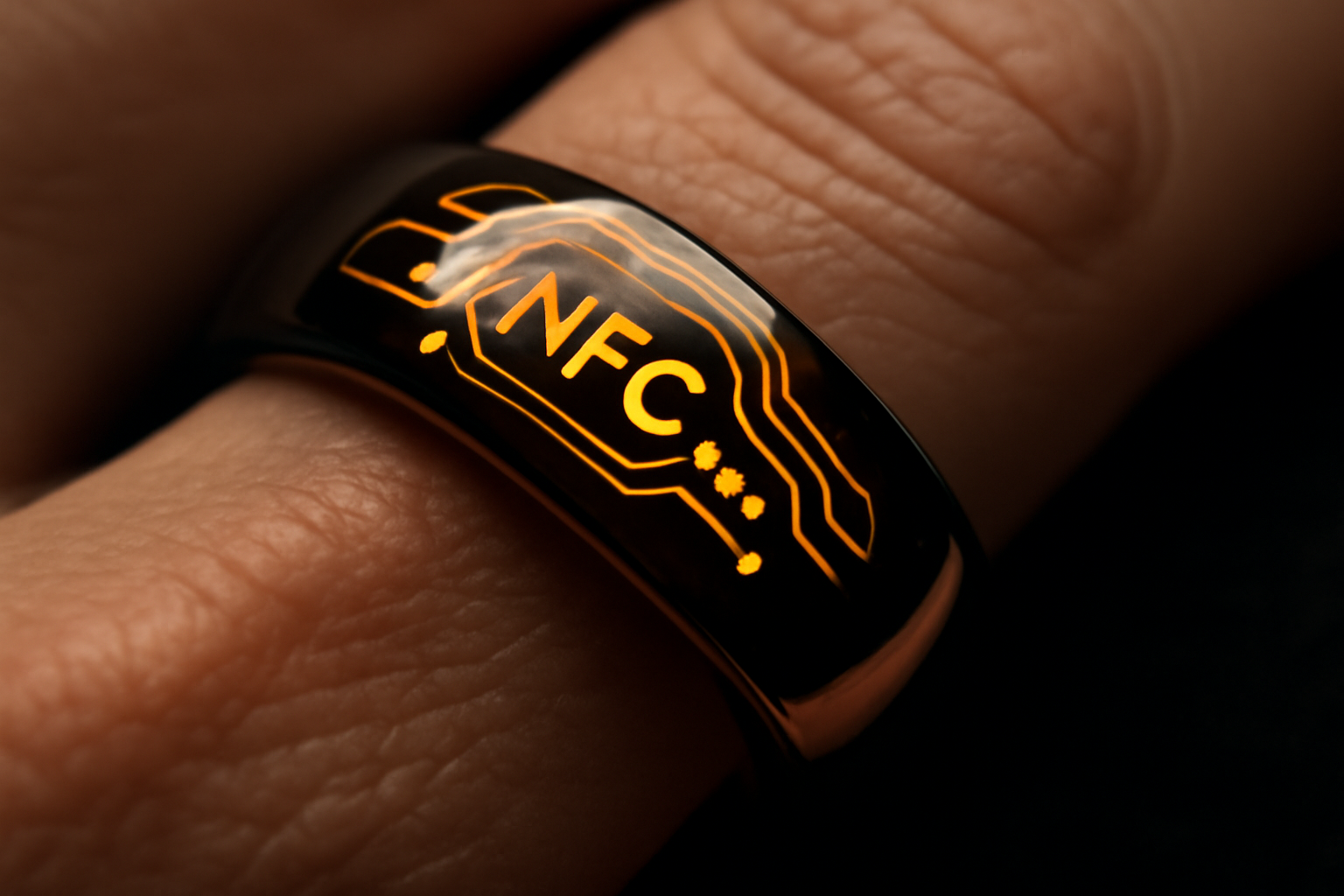
The Part Nobody Thinks About
You spend a lot of mental energy on introductions. What to say. When to say it. Whether to say anything at all.
The ring just sits there.
It does not need you to be ready. It does not care if you are nervous. It does not require a plan. When you finally decide to go for it, the hardest part is already handled before the other person even looks up.
That is a weird thing to think about. A piece of jewelry doing professional work. But that is exactly what a TapRing does.
What Is Actually Happening
Inside the ring there is a small NFC chip. No battery. No signal. Nothing running in the background. It just waits.
When you tap your ring against someone's phone, the chip responds to the phone's own NFC field. The phone does the reading. The ring does not broadcast anything. It does not ping. It does not need to be activated.
The phone opens a link. That link is your digital business card. Name, title, contact info, social links, whatever you put on it.
The whole thing takes under two seconds.
The Part That Surprises People
The other person does not need an app. That is the thing that trips people up the most when they first hear about it.
Most modern phones have NFC built in. It works on iPhones. It works on Android. It works on phones that have never downloaded anything unusual. The phone just reads the chip the same way it would read a payment terminal.
There is no pairing. No Bluetooth. No WiFi required. No QR code to line up. No waiting for a link to load on a bad connection.
You tap. They see your info. Done.
Why That Matters at an Actual Event
Networking environments are chaotic. Loud rooms. Weak signals. People moving. Glasses in one hand and plates in the other.
In that environment, every extra step you add to sharing your contact info is a step where something can go wrong.
Texting your number requires signal and their patience.
AirDrop requires them to accept something.
A QR code requires their camera, good lighting, and a steady hand.
Typing your contact into their phone requires handing over your phone or theirs and watching someone tap around with sticky fingers.
A tap requires none of that. Just proximity.
The Invisible Part of the Whole Thing
Here is what nobody talks about enough.
The ring is on your finger. Not in a bag. Not in a jacket pocket you forgot to check. Not buried under your phone and keys and a receipt from this morning.
It is on your hand.
Your hand is already out when you go to shake someone's hand. Which means the tool is already in position before you even think about it.
That is not a small thing. That is the whole thing.
Most networking tools require you to remember to bring them, find them, and then hand them over. The ring skips all three of those steps.
What Changes When You Wear It
You stop doing the mental calculation of whether it is worth it to try to exchange info with someone.
Usually that calculation includes things like: do I have a card left, will they even save it, is this the right moment, am I going to fumble around in front of them.
With the ring you already know the answer to all of those questions. Yes you have it. Yes they will get it in a format that actually saves. Yes the moment is right because the moment is always right. And no you will not fumble.
So you just do it.
That shift in confidence is quieter than it sounds. But it shows up every time.
The Short Version
The ring works because it removes the gap between wanting to connect and actually connecting.
No preparation. No equipment check. No hoping the other person has the right app or enough patience.
Just a tap. And your info is already in their hands.
TapRing starts at $45. The Pro plan is $5.99 a month or $2.99 a month on a yearly plan. One ring. Every room you walk into.