
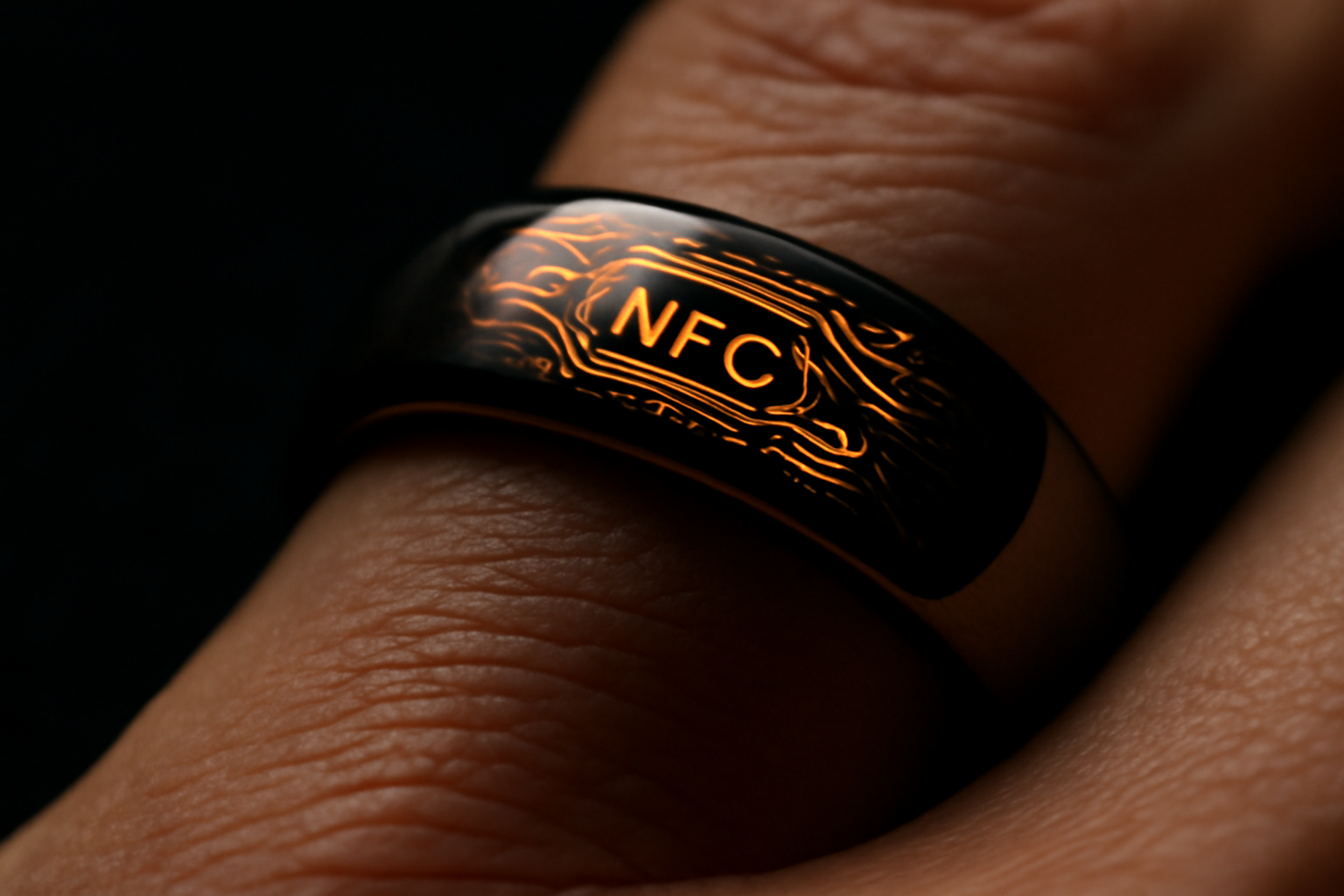
Most people assume there's a battery in there somewhere.
There isn't. No charging port. No battery compartment. No wireless radio sitting inside a band of resin or metal. And yet you tap your TapRing against a phone and something happens.
That feels like it shouldn't work. So here's why it does.
The Phone Does the Heavy Lifting
NFC stands for Near Field Communication. It's a standard built into almost every smartphone made in the last decade. When your phone's NFC reader is active, it broadcasts a tiny electromagnetic field. That field radiates outward about an inch or two.
When an NFC chip enters that field, something interesting happens. The chip absorbs energy directly from the field itself. That absorbed energy is just enough to power a single, fast operation: reading and transmitting a small amount of stored data.
The phone creates the field. The ring borrows from it. The ring sends back the data. The whole exchange takes less than half a second.
No battery required on the ring's end. The phone supplies everything the chip needs to do its job.
What's Actually Inside the Ring
Inside every TapRing is a tiny NFC chip attached to a copper antenna. The antenna is usually a small coil. It's designed to capture the electromagnetic energy from the phone's field as efficiently as possible.
The chip holds a small amount of memory. That memory stores a URL. That URL points to your TapRing profile.
When someone taps your ring to their phone, the phone reads that URL and opens it in a browser. They see your name, your contact info, your links. Everything you set up.
The chip itself doesn't know anything about you. It just holds the address. Your profile lives on TapRing's servers, not in the ring.
Why This Matters Practically
Because there's no battery, the ring doesn't die. It doesn't need to be charged. It doesn't fail because you forgot to plug it in the night before an important event.
Because there's no Bluetooth, there's no pairing process. No handshake. No asking the other person to turn something on.
Because the chip is passive, it has no moving parts and nothing that degrades from regular use. The antenna can survive being worn daily for years without losing function.
The technology is actually simpler than most people expect. That simplicity is the point. Fewer things to fail means fewer moments where the tool lets you down.
Why the Other Phone Doesn't Need an App
This is the part that surprises people most.
When the phone detects an NFC tag, the operating system handles the response natively. iOS and Android both have NFC reading built into the core software. The phone reads the URL stored in the chip and passes it to the browser automatically.
No app involved. No download prompt. No QR code scanner needed.
The person tapping your ring is essentially clicking a link. Their phone just happens to find that link through radio frequency instead of a screen.
This is why TapRing works on phones that have never downloaded anything related to NFC or digital business cards. The capability was already there. The ring just uses it.
The Part That Feels Like Magic Is Actually Engineering
Passive NFC has been around since the early 2000s. It's in contactless credit cards, transit passes, hotel key cards, and now rings.
The reason it feels surprising when it's in a ring is that rings aren't supposed to do things. They sit on your finger. They don't connect to anything.
But a ring that borrows power from the phone it touches and returns a URL in under a second doesn't need to be connected to anything. It just needs to be close enough.
One inch. Half a second. No app on their end. No battery on yours.
That's the whole trick.