
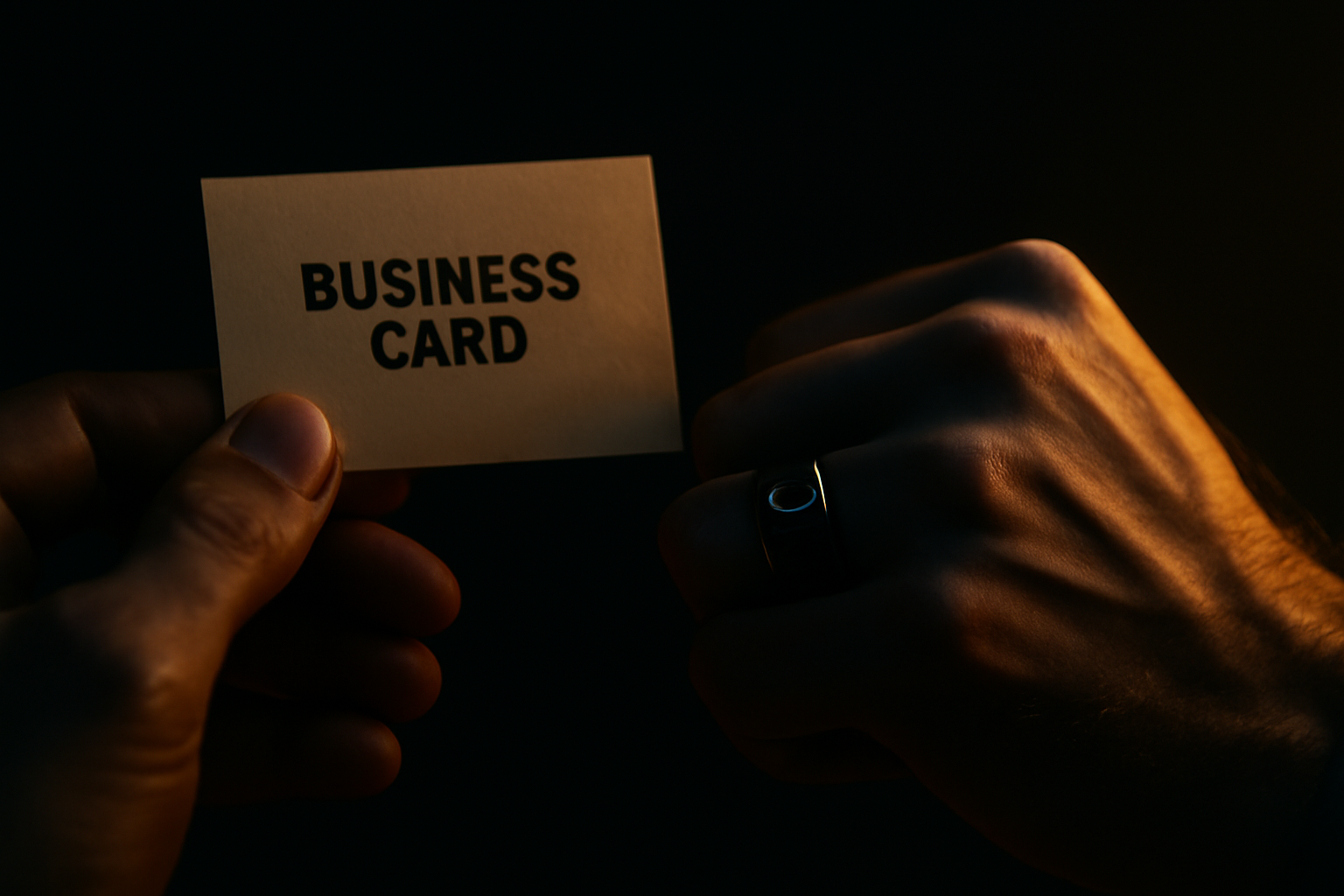
It Feels Bold in the Moment
Someone asks for your info. You do not have a card. You are not sure what to share. So you say it: just Google me.
It sounds confident. Like you are so findable that directions are unnecessary.
But think about what you just did. You handed the other person a task. You made your own contact information their homework.
What Happens After They Walk Away
They are going to try to Google you. Maybe tonight. Maybe tomorrow. Maybe three days from now when the memory of your conversation has faded enough that they cannot quite remember the context.
They type your name. If your name is common, they get results for five other people first. If your name is unusual, they might find you, but they land on whatever Google decides to surface. That might be your LinkedIn. It might be an old company bio. It might be a news article from four years ago that does not reflect who you are now.
You had no control over what they found. And you had no control over when they looked, or whether they looked at all.
The Problem With Findability as a Strategy
Being findable is good. Having a strong online presence matters. But findability is not the same as making it easy to reach you.
When someone asks for your info in person, they are in the highest-intent moment they will ever be. The conversation just happened. They are interested right now. The longer the gap between that moment and the moment they actually connect with you, the more that interest fades.
Every extra step in the process is a place where they stop.
Telling them to Google you adds multiple steps. TapRing adds zero.
What TapRing Does Instead
They tap your ring. Your profile opens on their phone immediately. Your name, photo, links, bio, email, everything you chose to include is right there.
They can save your contact in two taps. They can click your LinkedIn directly. They can pull up your website while you are still talking.
No search engine. No guessing which result is you. No hoping they remember your name correctly when they try later.
The information transfers in the room, while you are standing in front of them.
What You Signal When You Say Google Me
There is a version of this that sounds effortless. And there is a version that sounds like you did not prepare.
Most of the time, it sounds like the second one.
Because the people who are actually easy to reach do not make you search for them. They hand you the link. They make it obvious. They do not add friction and call it confidence.
Being easy to reach is a form of respect. It says your time matters and I am not going to waste it.
The Control Problem
When you tell someone to search for you, Google is now your first impression. Not you.
Maybe that is fine. Maybe everything Google surfaces about you is current, accurate, and exactly what you want a new contact to see.
But if you have changed jobs recently, rebranded, shifted your focus, or just have a common name, you are gambling. You are hoping the algorithm tells your story correctly.
TapRing gives you a profile you control entirely. You decide what is on it. You update it whenever things change. The person who taps it sees the version of you that you chose to present, not the version Google assembled from whatever it could find.
The Comparison in One Sentence
Telling someone to Google you is free and unreliable. TapRing starts at $45 and works every time.
One of those feels like a professional. The other feels like someone who ran out of cards and improvised.
You already know which one you want to be.